NVDA$188.46 +2.10%
AAPL$260.77 +1.84%
TSLA$360.59 -2.46%
MSFT$389.24 +0.72%
AMZN$198.12 +1.33%
META$541.30 +0.88%
AMD$112.45 +2.91%
NFLX$95.20 +1.52%
GOOGL$162.34 -0.41%
TSM$178.90 +0.83%
ASML$724.50 +1.12%
SPY$661.20 +0.45%
QQQ$528.40 +0.54%
NVDA$188.46 +2.10%
AAPL$260.77 +1.84%
TSLA$360.59 -2.46%
MSFT$389.24 +0.72%
AMZN$198.12 +1.33%
META$541.30 +0.88%
AMD$112.45 +2.91%
NFLX$95.20 +1.52%
GOOGL$162.34 -0.41%
TSM$178.90 +0.83%
ASML$724.50 +1.12%
SPY$661.20 +0.45%
QQQ$528.40 +0.54%
CLOSED
MOMENTUM OSCILLATOR

What Is the Stochastic Oscillator and How Do You Read It?

The Stochastic oscillator measures where a stock's current price sits within its recent high-low range. When price consistently closes at the top of its range, bulls are in control. At the bottom, bears. The crossover between %K and %D is one of the most widely-traded signals in all of technical analysis.

QUICK ANSWER

Stochastic above 80 doesn't mean sell immediately — in a strong trend, it can stay overbought for weeks. The actionable signal is a bearish crossover inside the overbought zone: when the %K line crosses below %D while both are above 80, the momentum shift is confirmed. APEX uses stochastic divergence — when price makes a new high but stochastic doesn't — as a high-confidence reversal warning, especially when RSI also shows divergence.

Stochastic Scale
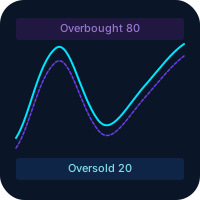
0 — OVERSOLD205080100 — OVERBOUGHT

Stochastic Zones

80–100
OVERBOUGHT
Price has closed near the top of its range for 14 sessions. In trending markets, this can persist for extended periods. In range-bound markets, this is a reversal warning. Wait for %K to cross below %D before acting.
50–80
BULLISH
Momentum favors buyers. Price is closing in the upper half of its 14-session range. Pullbacks to the 50 level in this zone are buying opportunities in uptrends.
20–50
BEARISH
Momentum favors sellers. Price is closing in the lower half of its range. Rallies to the 50 level in this zone are selling opportunities in downtrends.
0–20
OVERSOLD
Price has closed near the bottom of its range. Selling is exhausted in the near term. Wait for %K to cross above %D before entering long positions.

The %K/%D Crossover Signal

The most actionable Stochastic signal is the %K/%D crossover — when the faster %K line crosses above or below the slower %D line. The signal has higher reliability when it occurs in the overbought or oversold zones.

Bullish setup: Stochastic is below 20 (oversold). %K crosses above %D. Price has formed a higher low relative to its previous low. Enter long. Stop below the recent swing low. This is one of the cleanest reversal setups in technical analysis.

Bearish setup: Stochastic is above 80 (overbought). %K crosses below %D. Price has formed a lower high. Enter short or exit long. The signal is most reliable in range-bound conditions — in uptrends, only trade the bullish setup.

Real-World Examples

AAPL%K/%D CROSSOVER

AAPL's Stochastic crossed above the 20 line with a %K/%D bullish crossover in October 2023 — precisely at the multi-month low. The setup preceded a +28% rally over the following 10 weeks.

METASTOCHASTIC DIVERGENCE

META's Stochastic made higher highs in August 2023 while price stalled — classic bearish divergence. Price corrected 18% over the following 3 weeks before resuming its uptrend.

AMDOVERBOUGHT PERSISTENCE

AMD stayed above 80 Stochastic for 6 weeks during its AI-driven momentum phase in 2023. Traders who sold the first overbought reading missed +40% of additional upside — confirming that overbought in a trend means strength, not reversal.

Stochastic — Frequently Asked Questions

What is the difference between %K and %D in Stochastic?
%K is the raw Stochastic line — the current close relative to the high-low range of the past 14 sessions, expressed as a percentage. %D is a 3-period moving average of %K, which smooths the signal. Crossovers between %K and %D generate buy and sell signals: %K crossing above %D is bullish, below is bearish.
What are the best Stochastic settings?
The default 14/3/3 setting (14-period range, 3-period %K smoothing, 3-period %D) is the most widely used. Day traders often use 5/3/3 for more responsive signals. Swing traders sometimes use 21/5/5 to filter noise on daily charts. The faster the settings, the more signals — and more false signals.
What is the Stochastic RSI?
Stochastic RSI (StochRSI) applies the Stochastic formula to RSI values instead of price. The result is a more sensitive oscillator that identifies overbought/oversold conditions in the RSI itself. It oscillates between 0 and 1 (or 0 and 100). Values above 0.8 are overbought; below 0.2 are oversold. It generates earlier signals than either Stochastic or RSI alone.
How is Stochastic different from RSI?
RSI measures the speed and magnitude of price changes over 14 periods. Stochastic measures where price is closing relative to its high-low range over 14 periods. RSI is a momentum indicator; Stochastic is a range-position indicator. Both oscillate between 0 and 100 and have overbought/oversold zones — but they use fundamentally different calculations and generate different signals.
Does Stochastic work in trending markets?
Stochastic is most effective in range-bound markets where overbought and oversold levels reliably mark turning points. In strong trends, Stochastic can remain overbought or oversold for extended periods. Always check the trend first — in a strong uptrend, only trade Stochastic buy signals (from oversold), not sell signals from overbought.
A
APEX Intelligence Research Team
Signal Academy · Updated May 2026
All signal weights and scoring logic documented at APEX Methodology ↗. Not financial advice.
Run Stochastic on any stock

APEX combines Stochastic with RSI, MACD, and 5 other signals for complete momentum analysis.

Run a Free Analysis →
Analyze
Menu
Alerts
👤Account